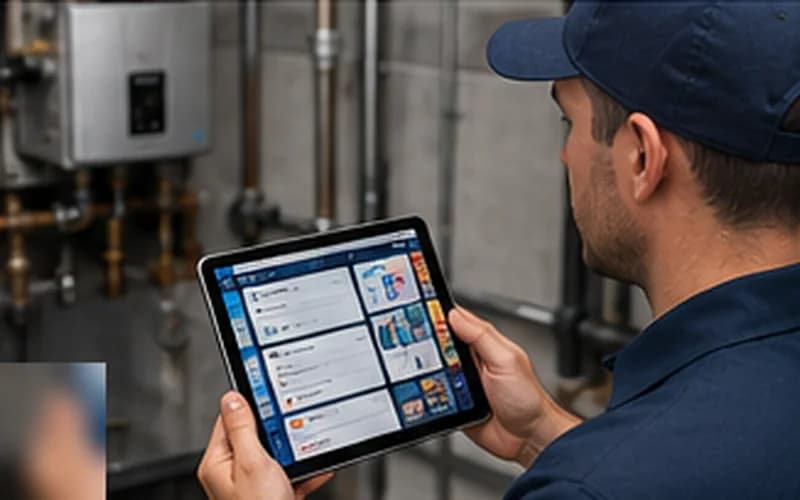
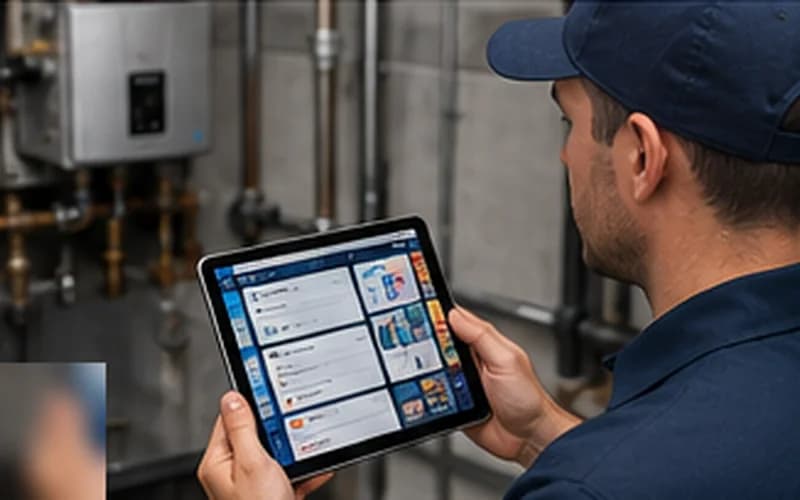
The HVAC trade has never had more complex equipment to service — condensing water heaters with cascade configurations, heat pump systems with variable-speed compressors, and multi-zone hydronic systems with advanced controls. At the same time, experienced technicians are retiring faster than apprentices are completing training. AI diagnostic platforms address this gap not by replacing technician judgment, but by delivering the right technical information — the right measurement to take, the right threshold to compare against — at exactly the moment it is needed on the job.
What an AI Diagnostic Tool Actually Does — Not What Marketing Says
The most effective AI tools for water heater diagnostics are not chatbots that answer general questions. They are structured diagnostic decision trees built from OEM service procedures, technician field experience data, and fault frequency analysis. When a technician enters the brand, model, and symptom or error code, the tool returns:
- checkA ranked list of probable root causes — ordered by frequency in the field, not alphabetically or by component cost
- checkA step-by-step diagnostic sequence with exact measurements: 'Measure resistance across the outlet thermistor. At current room temperature, functional range is X–Y Ω'
- checkDecision branches: 'If the reading is within range, proceed to Step 4. If the reading is out of range, the thermistor needs replacement — here is the OEM part number'
- checkSafety alerts: 'Before opening the gas valve, confirm you have verified gas pressure using a manometer — do not assume adequate pressure based on other appliances'
- checkAutomatic documentation: each step the technician confirms creates a service record that can be exported for warranty claims or callbacks
Real-World Time Savings — Where the Efficiency Comes From
Studies of field service operations consistently show that diagnosis accounts for 40–60% of total service call time. A technician who knows the brand well can diagnose a common fault in 10 minutes. The same technician on an unfamiliar brand in a complex multi-unit installation may spend 45 minutes just finding the service manual. AI tools eliminate the reference lookup time and compress the diagnostic path to the statistically most-likely causes first.
| Average diagnostic time reduction (common faults) | 25–35% faster for technicians familiar with the brand |
| Average diagnostic time reduction (unfamiliar brand/model) | 40–60% faster — primarily from eliminating reference manual search time |
| Callback rate reduction | 18–25% fewer callbacks when diagnostics are tool-guided vs. experience-only |
| Documentation time | Near zero when the tool auto-generates service records from confirmed diagnostic steps |
The biggest productivity gain is not on common calls — experienced technicians handle those efficiently with or without AI. The gain is on the 20% of calls that are unfamiliar brand, unusual fault combination, or cross-system interaction. That 20% of calls consumes 50%+ of diagnostic time.
What AI Cannot Replace — The Experienced Technician Advantage
AI tools handle information retrieval and structured decision sequences faster than any human. They do not replace field experience for several categories of diagnosis:
- checkSensory assessment: reading a flame for unusual color (yellow tips indicating CO risk), smelling for gas or burning components, hearing subtle bearing wear in a combustion fan — these require trained perception that AI cannot substitute.
- checkInstallation quality judgment: assessing whether a vent run has the correct slope, whether a gas line is correctly sized for the combined BTU load, or whether the water quality requires a softener — these are judgment calls based on experience with the local environment.
- checkCross-system interactions: a water heater fault caused by a shared gas line that is undersized because the furnace was just upgraded — this root cause requires understanding the system as a whole, not just the water heater in isolation.
- checkUnusual failure modes: a unit failing due to a rare manufacturing defect, a counterfeit part, or an unusual environmental condition (extremely high altitude, severe hard water chemistry) — these fall outside statistical models and require experienced pattern recognition.
How HeatDiagnose Implements AI-Guided Diagnostics
HeatDiagnose is built specifically for water heater diagnostics — not as a general AI assistant. The platform covers all major brands (Navien, Rinnai, Rheem, A.O. Smith, Bradford White, Noritz, Takagi, Bosch) and all water heater types (tankless gas, storage gas, electric, heat pump).
- checkError code lookup: search by brand and code number to get immediate meaning, causes ranked by frequency, and diagnostic steps with specific measurements.
- checkSymptom-based diagnosis: describe the symptom ('unit goes cold after 8 minutes') and the platform returns probable causes ranked by frequency for that symptom pattern.
- checkModel-specific data: diagnostic steps reference the specific component location, access procedure, and OEM resistance specifications for the unit model — not generic information.
- checkOffline capability: full diagnostic functionality is available without internet connectivity — critical for basement mechanical rooms and rural service areas with poor cell coverage.
- checkService record export: completed diagnostic sessions generate a PDF service record with the diagnostic path, confirmed readings, and performed actions — suitable for warranty submissions and callback protection.
Video Guide
Using AI to Troubleshoot HVAC Systems — Technician Field Demo
Use HeatDiagnose for guided step-by-step repair
Enter your brand, model, and error code — and get a yes/no diagnostic flow built from OEM service procedures.
Frequently Asked Questions
Do I need internet access to use HeatDiagnose on a job site?expand_more
No. HeatDiagnose supports offline use for the most common brands and fault types. The diagnostic data is cached locally so you can complete a full diagnostic session without cell service — important for basement mechanical rooms and rural service areas.
Will AI diagnostic tools replace HVAC technicians?expand_more
No — and the data shows the opposite trend. AI tools increase the productivity of existing technicians, allowing them to handle more calls per day with higher first-call resolution rates. The demand for experienced technicians continues to grow faster than supply. AI reduces the knowledge gap for apprentices and enables experienced technicians to handle unfamiliar equipment confidently, but the physical work, judgment, and safety responsibility remain with the technician.
Is the diagnostic data in AI tools accurate for my specific model?expand_more
Quality matters significantly. Tools built from OEM service documentation and real field data are accurate. Tools that rely on general AI training data (large language models without curated service data) often give generic, inaccurate advice. HeatDiagnose uses structured OEM-aligned data specific to each brand and model — not general AI knowledge.
Can I use HeatDiagnose to document warranty claims?expand_more
Yes. Completed diagnostic sessions generate a service record that documents the diagnostic steps taken, measurements recorded, and actions performed. This record meets the documentation requirements of most major manufacturers' warranty claim processes.