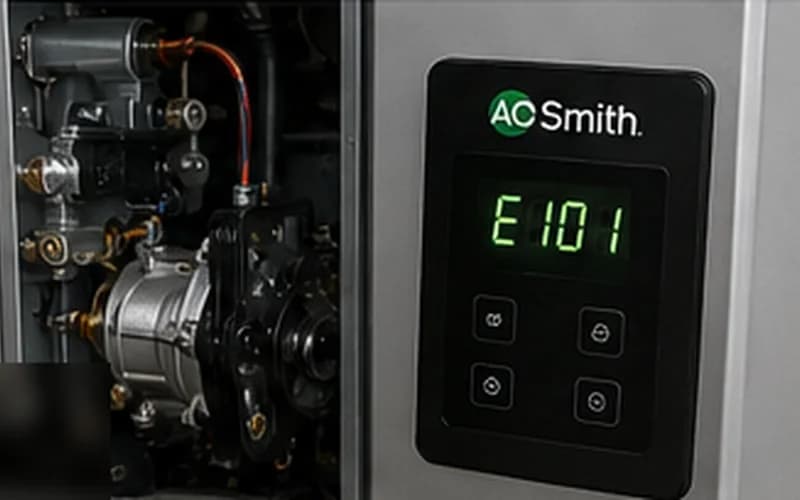
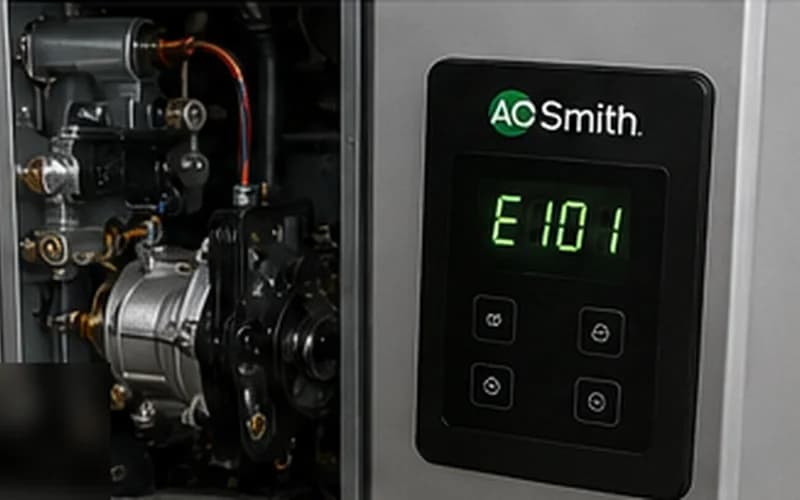
A.O. Smith produces a wide range of water heater types — tankless gas, gas storage, electric storage, and heat pump — and each type uses a different fault communication system. Tankless units display alphanumeric codes (E01, E02). Gas storage units with electronic ignition use LED blink patterns. Heat pump units (Voltex series) display a combination of codes and blink patterns on the GAMA-style control. This guide covers the diagnostic procedures for all three systems.
A.O. Smith Tankless Error Codes — ATI and ATSH Series
A.O. Smith tankless units share a control platform architecture with Navien and use similar E-prefixed codes. The ATI series (indoor) and ATSH series (outdoor) cover 120,000–199,000 BTU/hr output ranges.
- checkE01 — Ignition failure: three failed ignition attempts. Diagnostic sequence: gas supply pressure (NG min 3.5" WC), flame sensor rod cleaning, igniter electrode gap (3–4 mm), air intake inspection, and inlet filter screen.
- checkE02 — Flame loss during operation: burner ran then flame extinguished. Diagnostic priority: dynamic gas pressure under load, condensate drain (ATI condensing models), flame sensor ionization current at operating temperature.
- checkE05 — Outlet water temperature too high: outlet thermistor reading above upper safety limit. Check for scale buildup, low flow rate, or drifting thermistor.
- checkE06 — Inlet thermistor fault: cold-water inlet temperature sensor open or shorted. Measure resistance (NTC thermistor): at 68°F should read approximately 12,000 Ω.
- checkE07 — Outlet thermistor fault: hot-water outlet temperature sensor open or shorted. Measure resistance: at 120°F should read approximately 4,200 Ω.
- checkE10 — Low water flow: flow rate below activation threshold (0.4 GPM minimum). Check inlet filter, water supply valve, and fixture flow rate.
- checkE48 — Gas valve fault: solenoid control circuit error. Measure solenoid coil resistance (25–60 Ω per coil); inspect wiring harness connector for corrosion.
LED Blink Codes — Gas Storage Models (Signature and ProLine)
A.O. Smith gas storage water heaters with electronic ignition (no pilot light) communicate faults through a diagnostic LED located near the gas valve. Count the number of blinks in a repeating pattern. The pattern repeats every 3 seconds — a pause between groups of blinks indicates a new code cycle.
| 1 blink | Thermopile voltage too low — thermocouple or thermopile lead needs replacement, or gas valve connection is dirty |
| 2 blinks | Ignition failure — check for gas supply, pilot orifice blockage, or faulty igniter |
| 3 blinks | Temperature sensor fault — check thermistor resistance |
| 4 blinks | High-temperature lockout — unit reached 170°F (77°C). Check thermostat and T&P valve for proper calibration. |
| 5 blinks | Flame sense issue — similar to 2 blinks but flame detected without a call for heat (ghost flame). Check gas valve for internal bypass. |
| 7 blinks | Gas valve electrical fault — internal solenoid or control board communication failure |
| Continuous 4 Hz blink | Normal standby state — unit is operating normally |
The LED blink code on A.O. Smith gas storage units is often misread. Count carefully: 1-2-3 with a pause is three separate codes, not one code of '123.' Record the number of blinks in each group before a long pause — that is your fault code.
Voltex Heat Pump Water Heater — Fault Codes
A.O. Smith Voltex heat pump water heaters (HPTU series) use a digital display that shows alphanumeric codes when faults are detected. The heat pump system adds compressor and refrigerant circuit monitoring to the standard water heater faults.
- checkFP — Freeze Protection: the unit detected ambient temperature below 40°F and switched to electric resistance backup mode. This is a normal protective response, not a fault. Ensure the installation space temperature remains above 40°F during winter.
- checkHP — Heat pump fault: the compressor circuit has detected an abnormal condition. Check refrigerant charge (requires a refrigerant-certified technician) and verify no refrigerant leaks at the service valves.
- checkHE — High-efficiency fault: the unit's efficiency monitoring system detected performance below expected levels — often caused by a dirty air inlet filter. Clean or replace the air filter monthly in dusty environments.
- checkLo — Low ambient temperature lockout: ambient temperature below the heat pump's operating range (typically 37–40°F minimum). Unit automatically switches to electric resistance. Verify location is conditioned or add supplemental heating.
Refrigerant circuit work on the Voltex heat pump (compressor, refrigerant charge, service valves) requires a Section 608-certified technician. Do not attempt to charge or discharge refrigerant without proper certification and equipment.
Thermocouple and Thermopile Diagnostics — Gas Storage Models
On A.O. Smith gas storage models with a standing pilot (older installations), the thermocouple or thermopile generates the millivolt power that holds the gas valve open. A failing thermocouple is the most common cause of pilot outage and 'no hot water' on older storage units.
- checkTo test: light the pilot and let it warm for 90 seconds. Disconnect the thermocouple or thermopile lead from the gas valve. Measure millivolt output with a multimeter. Compare to specs above.
- checkIf output is within spec but the pilot goes out when you release the pilot button: the gas valve's holding coil has failed — replace the valve.
- checkIf output is below spec with the tip properly positioned in the pilot flame: clean the tip with fine steel wool, check tip positioning (must be fully in the flame), then replace if still below spec.
| Thermocouple output (functional, open circuit) | 30–42 mV DC measured at the gas valve connection with the pilot lit |
| Thermocouple output (failing) | Below 18 mV DC — gas valve will not hold open |
| Thermopile output (functional, open circuit) | 300–750 mV DC |
| Thermopile output (failing) | Below 180 mV DC |
| Test tool | Digital multimeter on millivolt DC setting |
Video Guide
A.O. Smith Water Heater Troubleshooting — Error Codes and What They Mean
Use HeatDiagnose for guided step-by-step repair
Enter your brand, model, and error code — and get a yes/no diagnostic flow built from OEM service procedures.
Frequently Asked Questions
Does A.O. Smith E01 mean the same thing as Navien E003?expand_more
Both indicate ignition failure, and the diagnostic sequence is similar: gas supply → flame sensor → igniter → venting → flow. However, the specific component locations, resistance specifications, and reset procedures differ between brands. Use the brand-specific service manual for exact values.
How do I access the service diagnostic mode on an A.O. Smith tankless unit?expand_more
On ATI/ATSH series: with the unit in standby, press and hold the Up and Down buttons together for 5 seconds. Navigate to the fault log using the arrow buttons. The unit stores the last 10 fault codes. Exit by pressing the Home button.
My A.O. Smith gas storage unit shows 4 blinks and shuts off. Is it dangerous?expand_more
Four blinks indicate the unit reached 170°F — the high-temperature safety limit. The unit shut down correctly. Do not bypass or ignore this. The most common causes are a failing thermostat (stuck closed — allowing burner to run past setpoint) or a T&P valve that has failed to open under the overpressure condition. Check and replace the thermostat and verify the T&P valve tests properly.