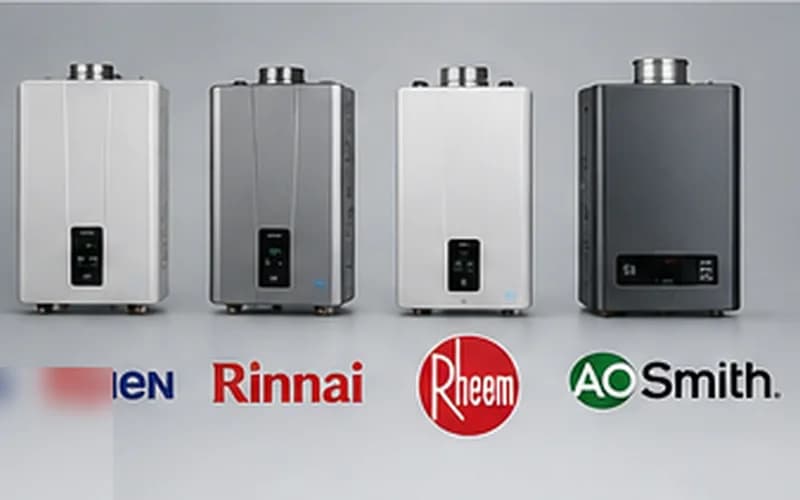
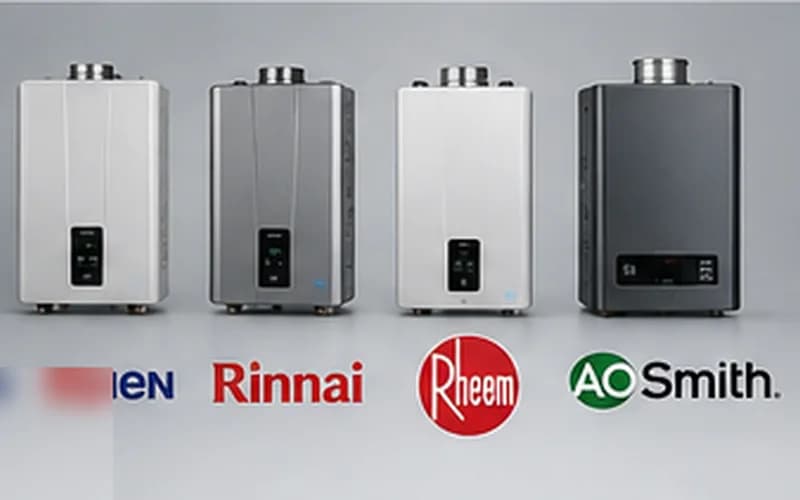
Tankless water heater error codes are fault indicators — not diagnoses. A code tells you which subsystem the control board detected a problem in; it does not identify the failed component. This guide gives technicians the complete framework: what each error category means electrically and mechanically, how to measure and test rather than guess, and where each major brand differs from the general playbook.
What Are Tankless Water Heater Error Codes?
Every tankless unit monitors its operation through a network of sensors: thermistors on the inlet and outlet, a flow sensor on the cold-water inlet, an ionization rod or flame sensor in the burner, pressure switches on the gas manifold, a combustion air fan tachometer, and in condensing models, a condensate level switch. The control board compares each sensor's reading to an expected range in firmware. When a reading falls out of range or a switch does not close within the allotted time, the board sets a fault code, shuts down the gas valve, and displays the code. The fault code identifies the sensor or subsystem — not the part that caused the reading to drift. A 'high outlet temperature' code could mean the thermistor is accurate and the heat exchanger is scaled, OR it could mean the thermistor is drifting and reporting a falsely elevated temperature while the water is actually within range.
Why Error Codes Are Only the Starting Point
The most common and costly diagnostic mistake is replacing the component the code names. Code 65 on a Rheem says 'flow sensor fault' — but in roughly 60% of field cases, the actual root cause is a clogged inlet filter screen restricting flow below the sensor's activation threshold. The sensor is reporting accurately. Before ordering parts, always complete the full diagnostic sequence: verify external conditions (gas, water, power), clean or replace serviceable items (filter screens, flame sensor rod), then test components against OEM specifications.
Document the error code, the conditions when it appeared (first call of the day vs. mid-cycle vs. high demand), and how many times it has recurred since the last service. This pattern often points directly to the root cause.
Common Error Code Categories
Every tankless water heater error code belongs to one of these eight fault categories. Understanding the category tells you which subsystem to investigate first.
Ignition Failure
Navien E003 · Rinnai 11 · Rheem 11 · A.O. Smith E01
The unit attempted to light the burner but the flame sensor did not confirm ignition. Root causes: closed gas valve, oxidized flame sensor rod, blocked air intake, or failed igniter electrode. Resolve gas supply and flame sensor before suspecting the igniter.
Flame Failure
Navien E012 · Rinnai 12 · Rheem 12 · A.O. Smith E02
Ignition succeeded but the flame extinguished during the heating cycle. Primary suspects: gas pressure drops under sustained load, venting backpressure, or a flame sensor rod losing signal conductivity during heat cycles.
Venting Problem
Navien E110 · Rinnai 14 · Rheem 13
Insufficient combustion airflow from a blocked intake, an improperly sloped vent, or a downdraft condition. Inspect both the air intake and exhaust termination externally before opening the unit.
Overheating
Navien E030 · Rinnai 31 · Rheem 14 · A.O. Smith E05
The heat exchanger or outlet temperature exceeded the safety threshold. Common causes: low water flow causing insufficient heat dissipation, scale buildup, or a failing thermistor giving erroneous high-temperature readings.
Water Flow Issue
Navien E007 · Rinnai 16 · Rheem 65 · A.O. Smith E10
Flow rate fell below the activation threshold. Check the inlet filter screen, verify the cold-water supply valve is fully open, and confirm the fixture's flow rate exceeds 0.5 GPM. A faulty flow sensor can also trigger this code.
Sensor Failure
Rheem 29 · A.O. Smith E06 / E07 · Navien E016
A thermistor or flow sensor reading outside the expected range. Test sensor resistance against the OEM temperature-resistance curve. A sensor reading open (infinite resistance) or shorted (near zero resistance) requires replacement.
Gas Supply Issue
Navien E003 / E012 · Rinnai 11 / 12
Low gas pressure, a partially closed shutoff valve, or a failing gas valve solenoid. Always verify gas pressure with a manometer under firing conditions — idle pressure can be within spec while dynamic pressure falls short.
Condensate Drain Issue
Navien E012 · Condensing unit drain backup
Condensing tankless units produce acidic condensate that must drain freely. A blocked condensate line creates backpressure in the heat exchanger, causing flame instability and mid-cycle shutdowns. Inspect and clear the drain line before other diagnosis.
Step-by-Step Diagnostic Workflow
Apply this sequence to any tankless water heater fault — regardless of brand or code number.
Record the code and symptom
Note the exact error code, what the user was doing when it appeared, and how long the unit has been in service. A code that only appears under high demand behaves differently than one on every call.
Check external supplies first
Verify gas supply, water inlet pressure, and electrical power before opening the unit. 40% of service calls are resolved at this step.
Clear the fault and reproduce
Reset the unit and reproduce the fault condition while observing. This confirms the code is active and not a stale memory fault.
Work from simple to complex
Clean filter screens, inspect vent terminations, and check sensor connections before ordering parts or opening sealed components.
Test components, don't guess
Use a multimeter to test thermistors, flow sensor output, and igniter continuity. A component that tests within spec is rarely the root cause.
Document and confirm repair
After resolving the fault, run the unit through a full cycle under normal demand before closing out the job. Document findings for warranty and service history.
Brand-Specific Notes
Navien
NPE and NCB series use E-prefixed codes. Always check the condensate trap on condensing models (E012 is often condensate-related). Navien units are sensitive to gas inlet pressure — verify with a manometer, not just by testing other appliances.
Rinnai
RL, RU, and Sensei series use two-digit numeric codes. Code 11 and 12 share most causes but differ in timing — 11 at startup, 12 mid-cycle. Rinnai's minimum flow rate (0.4 GPM) is one of the lowest in the industry; low-flow complaints are common on older installations.
Rheem
RTG and RTGH series use two and three-digit codes. Thermal fuse (code 14) is non-resettable — confirm the overheating condition before replacing the fuse or the fault will recur. Code 65 (flow sensor) is often a dirty inlet filter, not a failed sensor.
A.O. Smith
ATI and ATSH series use E-prefixed codes similar to Navien (both use similar control platforms). Gas storage models without displays communicate via LED blinks — count carefully, as 4-blink (overtemp) and 5-blink (sensor) look similar at a glance.
Common Mistakes to Avoid
- warningReplacing the gas valve before testing gas supply pressure
- warningCleaning the flame sensor rod after replacing the igniter — always clean the sensor first
- warningOrdering a flow sensor when the actual cause was a clogged inlet filter screen
- warningResetting the thermal fuse without identifying and fixing the overheating condition
- warningMeasuring gas pressure only at idle — always test under full firing conditions
- warningIgnoring vent termination condition on units that only fault in winter or windy weather
When to Replace Parts
Flame sensor rod
Cleaned twice and unit still fails to detect flame — rod is cracked or the ceramic insulator is compromised
Igniter electrode
Visible cracks in the ceramic, gap is out of spec, or multimeter shows open circuit across the element
Flow sensor
Turbine is mechanically seized or the magnet is corroded — cleaning does not restore pulse output
Thermistor
Resistance at ambient temperature is more than 10% outside the OEM resistance curve
Thermal fuse
Any time it trips — it is a one-time safety device, never reusable
Gas valve
Solenoid coil resistance is out of OEM spec, or the valve passes the electrical test but still does not open under firing conditions
How HeatDiagnose Helps
HeatDiagnose is an AI-powered diagnostic platform built for plumbers and HVAC technicians. Instead of reading through a 200-page service manual on a job site, technicians enter the brand, model, and error code — and the platform returns a structured yes/no diagnostic flow built from OEM procedures.
- checkError code lookup for Navien, Rinnai, Rheem, A.O. Smith, Bradford White, Noritz, and more
- checkStep-by-step guided diagnostic flows that adapt to your findings
- checkBrand-specific wiring diagrams, part numbers, and OEM procedure references
- checkOffline support — works on job sites without reliable connectivity
- checkService history documentation for warranty and callback protection
Tools You May Need
Video Guide
Tankless Water Heater Error Codes — Complete List with Meanings and Fixes
Use HeatDiagnose for guided step-by-step repair
Enter your brand, model, and error code — and get a yes/no diagnostic flow built from OEM service procedures.
Frequently Asked Questions
Can I reset a tankless water heater without fixing the underlying fault?expand_more
Yes — but the code will return in the next cycle or within minutes. Repeated forced resets without diagnosis stress the igniter, gas valve solenoid, and control board. Find the root cause first.
Do all brands use the same error code numbering?expand_more
No. Each manufacturer uses its own code schema. Navien uses an 'E' prefix (E003, E012). Rinnai uses two-digit numbers (11, 12). Rheem uses two-digit numbers that overlap with Rinnai numerically but mean different things. A.O. Smith uses an 'E' prefix similar to Navien. Always reference the brand-specific service manual.
How do I access the fault history on a Navien unit?expand_more
On Navien NPE/NCB series: press the Home button, then navigate with arrow keys to Error History in the service menu. The unit stores the last 20 fault codes with timestamps. This is invaluable for intermittent faults — you may find code E010 (combustion air) appearing only at night, suggesting downdraft rather than a blockage.
Why does the same error code resolve itself sometimes?expand_more
Intermittent codes are usually caused by sensor degradation (a thermistor whose resistance drifts near the fault threshold under heat), a loose wiring connector that opens under vibration, or an environmental condition (low gas pressure during peak demand hours, vent freezing on cold nights). Log the time and conditions of each occurrence.
What is the difference between a safety lockout and a soft fault?expand_more
A soft fault allows the unit to retry after a short delay or a manual reset. A hard lockout requires a power cycle or physical Reset button press. Codes related to ignition failure, overtemperature, and gas valve faults are typically hard lockouts. Codes related to sensors reading out-of-range may be soft faults that clear when the reading returns to normal.
When should I call a factory-authorized technician instead of diagnosing myself?expand_more
Call a factory-authorized technician when: (1) you smell gas at any point, (2) the unit is within the warranty period and the fault requires component replacement, (3) the fault persists after completing all standard diagnostic steps, or (4) the fault code points to the gas valve, control board, or heat exchanger assembly — these require gas-certified tools and procedures.