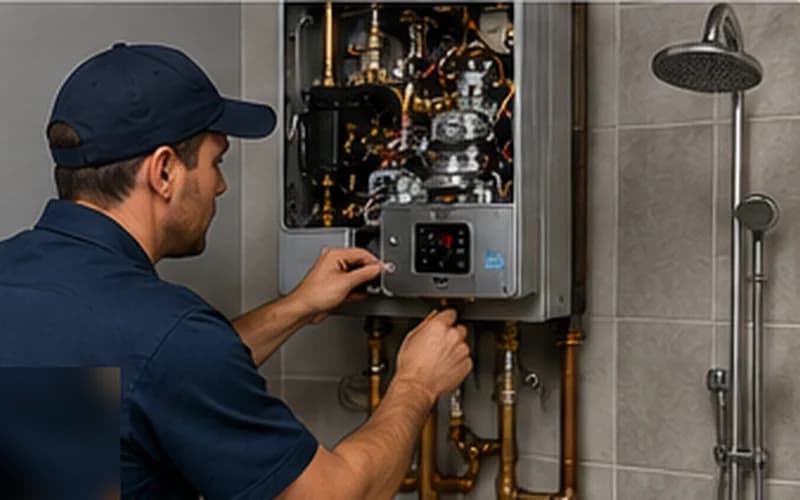
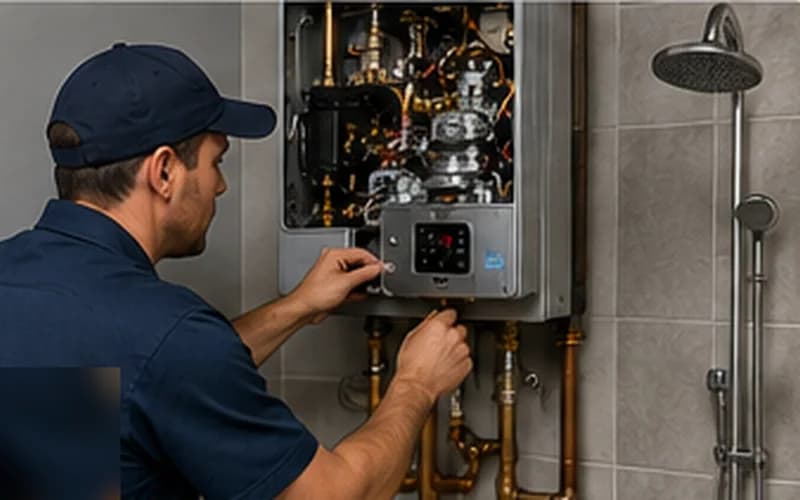
A tankless water heater that produces no hot water is the most time-sensitive service call in the trade — every minute without hot water is visible to the customer. The key to resolving it efficiently is a structured decision tree that eliminates whole subsystems in 30-second checks before doing component-level work. This guide follows that tree: from the circuit breaker to the thermistor, in the order that resolves the majority of calls in the fewest steps.
30-Second Triage — Before Touching the Unit
Complete this checklist before opening the unit or picking up a meter. It resolves 30–40% of no-hot-water calls without any component work:
- checkCircuit breaker: check the breaker for the water heater at the panel. A tripped breaker may not look obviously tripped — push it firmly to OFF before resetting to ON.
- checkGFCI outlet (if unit plugs in): test the GFCI outlet the unit is plugged into. Press Test, then Reset.
- checkGas shutoff valve: confirm the valve handle is parallel to the pipe (open), not perpendicular (closed).
- checkCold-water inlet valve: confirm fully open. A partially closed valve drops flow below the activation threshold.
- checkDisplay panel: is there a displayed error code? If yes, go to that specific code's diagnostic guide. If the display is blank/off, the unit has no power.
- checkOther gas appliances: light a gas stove burner to confirm gas supply is live at the meter.
- checkHot-water outlet: confirm the hot-water fixtures are actually calling for hot water and not blocked by a closed fixture shutoff.
Unit Powers On But Never Fires — Systematic Diagnosis
If the display is on and shows normal status (no error code) but the unit never heats water, the most common causes are: water flow below the activation threshold, a failed flow sensor, or a gas valve that is not receiving an open signal. Work through these in sequence:
- checkFlow check: measure GPM at the furthest hot-water fixture using a 5-gallon bucket and a stopwatch. Most tankless units require 0.4–0.5 GPM minimum. If flow is below threshold, the burner will not fire — check the inlet filter and fixture aerators.
- checkFlow sensor test: with power on and a call for hot water, use a multimeter to measure the pulse output at the flow sensor terminals on the PCB (5V DC pulse signal that pulses in proportion to flow rate). No pulse = stuck or failed sensor.
- checkGas valve solenoid: with a call for hot water active and flow confirmed, use a multimeter to measure DC voltage at the gas valve solenoid terminals. Functional PCB should output 12–24V DC to open the valve. If voltage is present but the valve does not open (audible click), replace the gas valve.
On units with a service/diagnostic mode, put the unit into manual burner fire mode to isolate the gas valve and igniter from the flow sensor circuit. Check your model's service manual for the activation procedure.
Unit Fires But Water Is Lukewarm or Cold
If the burner fires (you hear ignition and the combustion fan running) but the water exits at lower than the set temperature, the problem is in the heat transfer path rather than the ignition chain:
- checkSet point verification: check the temperature set point on the display. Confirm it is set to the correct target (typically 120°F for residential, 110°F for safety with young children or elderly).
- checkHeat exchanger scale: a heavily scaled heat exchanger (calcium/magnesium deposits from hard water) acts as insulation. The burner runs at normal output but heat cannot transfer to the water. Descaling is required — this is the most common cause in units over 3 years old in hard water areas.
- checkOutlet thermistor drift: if the outlet thermistor is reading falsely high (say, showing 130°F when the actual water temperature is 100°F), the PCB modulates the gas valve closed before the water reaches the set temperature. Test thermistor resistance against the temperature-resistance curve.
- checkModulating gas valve: if the valve is not opening to full modulation (stuck at low fire), BTU output is limited. Test by increasing set point to maximum and measuring BTU output (flow rate × temperature rise × 8.34).
| Thermistor resistance at 70°F (21°C) | ~11,500 Ω (NTC type — verify against model spec) |
| Thermistor resistance at 120°F (49°C) | ~4,200 Ω |
| Thermistor resistance at 140°F (60°C) | ~2,400 Ω |
| Open thermistor (failed) | ∞ — will cause unit to run at minimum output |
| Shorted thermistor (failed) | Near 0 Ω — will cause unit to shut down on overtemp fault |
Unit Completely Dead — No Display, No Fan
If the unit shows no signs of life, the power supply is the starting point. This applies to both 120V plug-in units and 240V hard-wired units.
- checkMeasure voltage at the unit's power terminals or outlet: 120V plug-in should read 115–125V AC; 240V hard-wired should read 230–250V AC.
- checkCheck the unit's internal fuse: most tankless units have a glass or blade fuse on the PCB. Consult the model's service manual for fuse location and rating.
- checkIf voltage is present and the fuse is good but the unit is still dead, the PCB main power section has failed and requires replacement.
- checkCheck for surge damage: tankless water heaters are sensitive to power surges. A unit that went dead immediately after a storm or power restoration may have a burned PCB. Look for visible burn marks on the board.
Video Guide
Tankless Water Heater No Hot Water — Diagnosis and Fix Guide
Use HeatDiagnose for guided step-by-step repair
Enter your brand, model, and error code — and get a yes/no diagnostic flow built from OEM service procedures.
Frequently Asked Questions
Why does my tankless water heater have hot water in the morning but not in the evening?expand_more
Evening-specific failures often point to gas supply pressure drops during peak residential demand hours. Multiple neighbors drawing on the gas main simultaneously reduces line pressure. Measure dynamic gas pressure during the evening failure period with a manometer to confirm.
Can cold incoming water temperature reduce output temperature?expand_more
Yes. Tankless units heat water by a fixed temperature rise (the unit's modulating output). In very cold climates, when the incoming water temperature is 35–40°F, even a unit running at full output may only raise the temperature 80–85°F — delivering 115–125°F at the outlet. This is not a fault. It means the unit's BTU output is inadequate for the climate. A larger unit is needed.
How do I know if my heat exchanger needs to be replaced vs. descaled?expand_more
If the heat exchanger has visible external corrosion, a water leak, or pinhole damage, it must be replaced — descaling cannot fix structural damage. If the unit has never been descaled, is in a hard-water area, and produces warm but not hot water with no error codes, descaling is the appropriate first step.