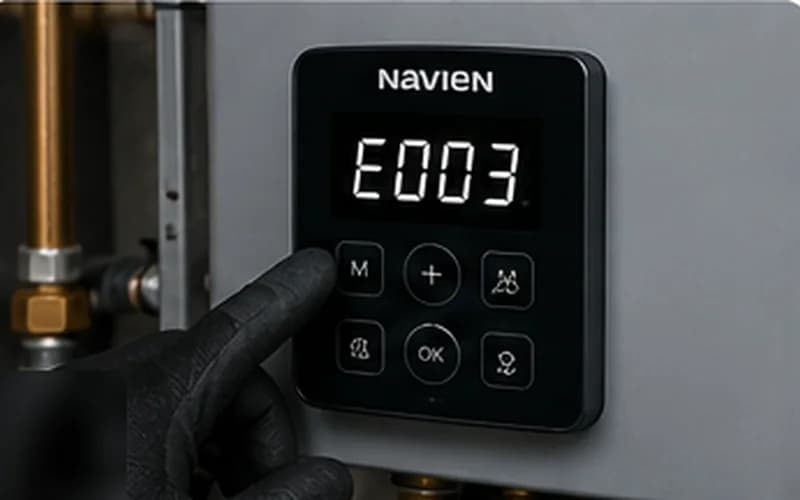
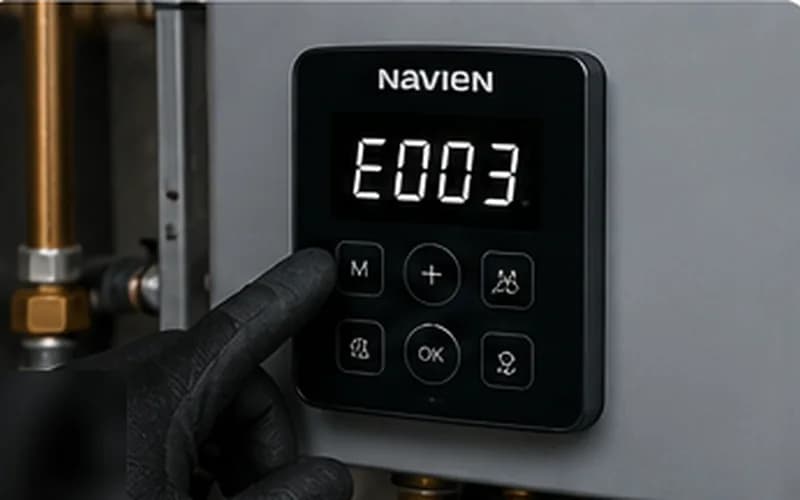
Navien error code E003 appears when the NPE or NCB series unit attempts ignition three times and the flame sensor rod does not confirm a sustained flame within the allotted window (approximately 3 seconds per attempt). The control board closes the gas valve and locks out for safety. This is not a component failure notification — it is a report that the ignition sequence did not complete successfully. The root cause could be anywhere in the ignition chain: gas supply, igniter, flame sensor, combustion air, or water flow.
E003 vs. E004 vs. E012 — Know the Difference
Navien uses related codes for ignition-area faults. Understanding which code appeared tells you where in the sequence the problem occurred:
- checkE003 — Ignition failure: spark fired (or attempted), but flame was never established. Focus on gas supply and igniter.
- checkE004 — Ignition failure on DHW (domestic hot water) side only (NCB combo units). Same causes as E003 but isolated to DHW burner.
- checkE012 — Flame loss during operation: ignition succeeded, burner ran, then flame extinguished mid-cycle. Focus on gas pressure stability and condensate drain.
- checkE013 — False flame signal: flame sensor detected current without a call for heat. Indicates a faulty sensor rod or wiring short.
Step 1 — Verify Gas Supply and Pressure
Before touching the unit, confirm gas is reaching the heater at adequate pressure. Use a manometer connected to the 1/8" NPT pressure test port on the gas inlet (just upstream of the inlet shutoff, or use the port on the manifold). Measure both static (burner off) and dynamic (burner firing — trigger using a secondary hot water outlet to force ignition).
| Natural gas static pressure | 5.0–7.0" WC (ideal); min 3.5" WC |
| Natural gas dynamic (firing) pressure | Must not drop below 3.5" WC |
| LP/Propane static pressure | 11.0" WC (ideal); min 8.0" WC |
| LP/Propane dynamic (firing) pressure | Must not drop below 8.0" WC |
If pressure drops more than 0.5" WC between static and dynamic readings, the gas supply line is undersized or there is excessive demand on the shared line. Do not attempt further diagnosis until the supply issue is corrected.
Step 2 — Clean the Flame Sensor Rod
The flame sensor rod operates on the principle of flame rectification: a small AC voltage applied to the rod produces a DC current when a flame is present (because flames conduct electricity in one direction). Oxidation on the rod tip insulates it and blocks this current, making the control board interpret the result as 'no flame detected' even when ignition briefly succeeds. Cleaning the rod resolves approximately 40–50% of all E003 calls.
- checkTurn off gas supply at the shutoff valve and disconnect power at the circuit breaker.
- checkLocate the flame sensor rod — a thin metal rod with a ceramic white insulator, positioned beside the burner. Do not confuse it with the igniter electrode.
- checkUse 0000-grade fine steel wool or 320-grit emery cloth. Rub the rod tip gently in one direction to remove the gray-brown oxidation layer. Do not use coarse sandpaper — it removes too much metal.
- checkInspect the ceramic insulator for cracks or carbon tracking. A cracked insulator allows current to leak to ground and cannot be fixed by cleaning — replace the rod assembly.
- checkReinstall, restore power and gas, and test before continuing to other steps.
On Navien NPE-150A through NPE-240A, the flame sensor rod is accessible after removing the front panel — it requires a ¼" hex driver, not a screwdriver.
Step 3 — Test the Igniter Electrode
If the unit still fails after cleaning the flame sensor rod, the igniter electrode may not be producing a spark — or it may be sparking at the wrong point. Disconnect the igniter lead wire and measure resistance across the igniter electrode terminals with a multimeter set to resistance (Ω).
| Igniter resistance (functional) | 1–20 kΩ (varies by model — check OEM spec) |
| Igniter resistance (open/failed) | ∞ (overload reading) — replace electrode |
| Igniter spark gap (target) | 3–4 mm (0.12–0.16"). Check with feeler gauge. |
| Electrode insulator condition | No cracks, no carbon tracking, ceramic clean and white |
Do not fire the unit with the burner housing open to observe spark — this is a gas appliance. Use a voltmeter on the igniter lead to confirm drive signal from the control board instead.
Step 4 — Inspect the Venting System
Navien units are direct-vent appliances. Both the air intake pipe and the exhaust vent pipe must be clear and properly terminated. A partial blockage in the intake does not always trigger a dedicated vent fault code — it can simply cause poor combustion that prevents stable ignition, resulting in E003 rather than E110 (exhaust blockage).
- checkInspect the outdoor intake and exhaust terminals for debris, bird nests, ice accumulation, or insect screens that have become clogged with lint.
- checkVerify both pipes have no sags, which would pool condensate and create airflow restriction.
- checkConfirm the intake and exhaust terminals are separated by at least 12 inches (Navien requirement) to prevent flue gas recirculation.
- checkOn concentric vent systems, ensure the inner pipe (exhaust) end extends 2 inches beyond the outer pipe (intake) terminal.
- checkOn Category III stainless steel venting, check all joints for proper lap-and-seal alignment. A joint that has backed out half an inch creates CO risk and combustion air imbalance.
Step 5 — Check Cold-Water Inlet Filter Screen and Flow Rate
The flow sensor switch will not close and the burner will not fire if water flow is below 0.5 GPM on NPE series units. A partially clogged inlet filter screen can restrict flow exactly to this threshold, causing the unit to appear to 'try' to ignite (fan spins, igniter sparks) but never complete the cycle.
- checkClose the cold-water inlet valve. Unscrew the hex union or inlet fitting and extract the mesh filter screen.
- checkInspect for white mineral deposits (calcium/magnesium scale in hard water) or brown sediment.
- checkRinse under running water. Soak in white vinegar for 15 minutes if scale is present. Rinse again.
- checkReinstall the screen, open the valve, and verify flow: at the farthest hot-water fixture, measure GPM using a bucket and stopwatch. Must exceed 0.5 GPM.
- checkIf flow is adequate but the unit still faults, the flow sensor itself may be mechanically stuck — see the flow sensor guide for testing procedures.
Advanced: Gas Valve Solenoid Test
If all five steps above pass and E003 persists, suspect the gas valve. The Navien gas valve has two solenoid coils — the main valve and the modulating valve. Disconnect the wiring harness and measure coil resistance across each terminal pair.
| Gas valve solenoid coil (typical) | 25–60 Ω per coil (check OEM spec for your model) |
| Failed coil reading | ∞ (open) or <5 Ω (shorted) — replace valve |
| Wiring harness connector check | Corrosion at the connector pins is the most common 'valve fault' cause — clean with electrical contact cleaner before replacing the valve |
Gas valve replacement must be performed by a licensed gas fitter. Do not attempt to open or repair the valve body — replace as a complete assembly.
Video Guide
How to Fix Navien Error Code E003 — Ignition Failure Step-by-Step
Use HeatDiagnose for guided step-by-step repair
Enter your brand, model, and error code — and get a yes/no diagnostic flow built from OEM service procedures.
Frequently Asked Questions
How do I reset Navien error code E003?expand_more
Press the power button to turn the unit off, wait 30 seconds, then press it again. On models with a physical Reset button on the control panel, hold it for 3 seconds. If E003 returns in the next ignition cycle, the underlying cause has not been resolved.
Why does Navien E003 only happen in the morning?expand_more
Cold-start ignition failures that resolve after the first use of the day often point to a dirty flame sensor rod. At cold ambient temperatures, oxidation on the rod tip has higher electrical resistance, which prevents the flame rectification circuit from detecting the flame signal. Once the unit is warm, the oxidation resistance drops slightly and ignition succeeds. Clean the flame sensor rod.
Can a dirty air filter cause E003 on indoor Navien units?expand_more
Yes. Navien NPN and some indoor-installation NPE models have an air intake filter on the combustion air inlet. A clogged filter starves the burner of oxygen, preventing stable ignition. Check and clean or replace the intake filter as part of annual maintenance.
What is the Navien fault history and how do I access it?expand_more
Navien NPE and NCB units store the last 20 fault codes in a service log. Access it by pressing the Menu/Info button on the display and navigating to Error History. Each entry shows the code, date, and time — invaluable for diagnosing intermittent E003 faults that don't reproduce on the service call.