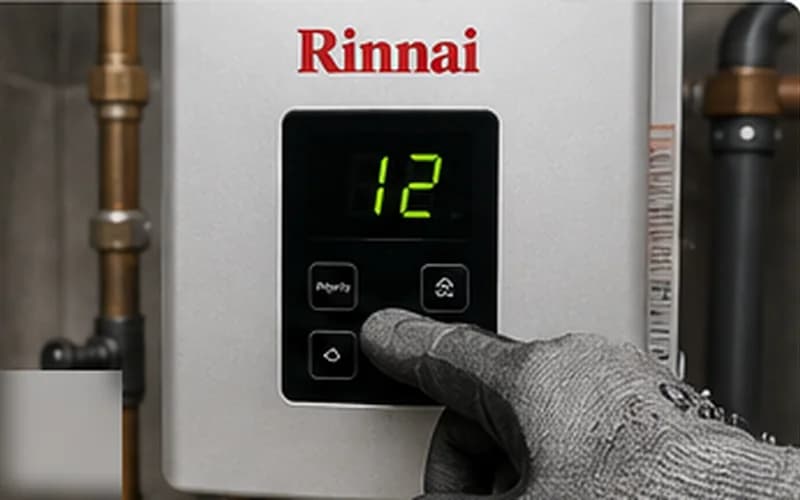
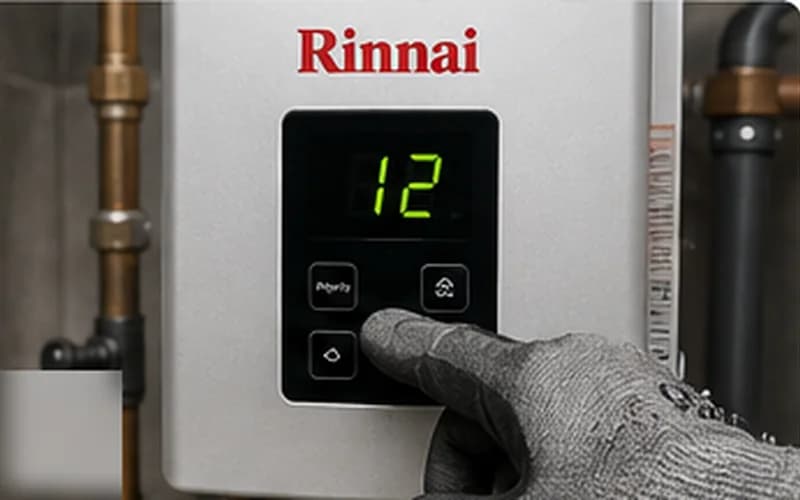
Rinnai error code 12 is a mid-cycle flame loss. The unit's ionization circuit detected a flame at startup — the sequence completed successfully — but during the heating cycle, the ionization current dropped to zero and the PCB shut the gas valve. This specific timing (flame established then lost) is the diagnostic key. It shifts suspicion away from the igniter, startup gas pressure, and flow activation, and toward the three things that change during sustained operation: gas supply pressure under load, venting back-pressure under wind or obstruction conditions, and the ionization rod's signal quality at operating temperature.
Code 11 vs. Code 12 — The Diagnostic Split
Before beginning work, confirm which code is displaying. On Rinnai units, code 11 and code 12 look similar at a glance but require completely different diagnostic paths:
- checkCode 11 = ignition failed — the unit never established a flame. Diagnose: gas supply, igniter, ionization rod, venting (air-flow proving), and inlet flow rate.
- checkCode 12 = flame established, then lost — the unit ran the burner and then the flame went out. Diagnose: gas supply under load, vent backpressure, ionization rod at temperature, and heat exchanger scale.
- checkIf the unit is audibly sparking and the flame can be heard igniting briefly before it goes out — that is code 12 behavior. If there is no audible flame burst at all — that is code 11.
Gas Pressure Under Firing Load — The Most Common Root Cause
A supply line that delivers adequate static pressure may still have insufficient dynamic capacity when the Rinnai fires at full modulation (180,000 BTU/hr on the RU199). The pressure drops, the gas valve senses insufficient delivery, and the PCB shuts down and flags code 12. This is particularly common when the water heater shares a main supply with a gas dryer, furnace, and stove.
| Test method | Manometer at inlet port, with ALL gas appliances running |
| NG minimum dynamic pressure | 3.5" WC — must not drop below this while unit fires |
| LP minimum dynamic pressure | 8.0" WC — must not drop below this while unit fires |
| Gas valve inlet port location | 1/8" NPT test port on Rinnai gas valve body, left side |
If the dynamic pressure drops during firing but the supply company confirms adequate main line pressure, the issue is often the service line diameter (undersized for the combined BTU load). A gas fitter needs to upsize the service line.
Ionization Rod at Operating Temperature
A marginal ionization rod may produce adequate current on a cold start but lose signal integrity after the unit has been running for several minutes. The mechanism: a thin oxide layer on the rod tip has higher electrical resistance at elevated temperatures, eventually breaking the ionization current loop. This produces code 12 reliably after a fixed run time — typically 5–15 minutes.
- checkClean the ionization rod as described in the code 11 guide (0000 steel wool, rod tip only).
- checkAfter cleaning, fire the unit and let it run continuously for 15 minutes while monitoring for code 12.
- checkIf cleaning resolves the issue, the rod was marginally contaminated. If code 12 returns, test ionization current with a multimeter in microamp mode:
- checkConnect the microamp meter in series with the ionization lead wire. Functional ionization current: 1.5–3.0 µA DC. Below 1.0 µA is marginal. Consistent readings below 0.5 µA means the rod needs replacement.
Venting Backpressure and Downdraft
Intermittent code 12 that correlates with weather conditions (wind direction, rain, temperature) almost always points to the venting system. A code 12 that only appears on windy days, or during afternoon when temperature and pressure change, is very unlikely to be a component fault.
- checkInstall the unit and run it under the exact conditions when the fault occurs — do not diagnose on a calm day if code 12 happens only in wind.
- checkVerify the exhaust termination faces away from the prevailing wind. If not possible, install a wind-resistant exhaust cap (Rinnai part number varies by vent diameter).
- checkInspect for nearby exhaust sources: dryer vents, other HVAC exhausts, or parking areas where vehicle exhaust could affect the intake air quality.
- checkConfirm exhaust is not recirculating into the intake — Rinnai requires a minimum 12" separation between exhaust and intake terminals.
Do not block or cap the exhaust termination during testing. Combustion gases can back-draft into the building. Test venting while the unit is firing from a safe distance.
Heat Exchanger Scale — Flame Instability from Hot Spots
Heavy scale (more than 1/16" thick) on the primary heat exchanger surface disrupts the combustion pattern. Gas that would normally mix uniformly in the burner chamber encounters a rough, irregular surface, causing turbulent flow that destabilizes the flame. The unit ignites normally but the flame cannot sustain itself under scale-induced turbulence.
- checkAssess scale using the heat exchanger descaling test: connect a submersible pump and bucket to the inlet/outlet service valves. Run clean water through the heat exchanger and observe the discharge. Heavy scale produces cloudy, white-gray discharge.
- checkDescale using a citric acid or white vinegar solution (20% concentration) circulated for 45 minutes.
- checkAfter descaling, flush thoroughly with clean water and cycle the unit 5 times under normal demand.
- checkIf code 12 persists after descaling, request an internal heat exchanger inspection — a cracked or delaminated surface cannot be restored by chemical cleaning.
Video Guide
Code 12 on a Rinnai Tankless — Checking the Flame Rods
Use HeatDiagnose for guided step-by-step repair
Enter your brand, model, and error code — and get a yes/no diagnostic flow built from OEM service procedures.
Frequently Asked Questions
Does code 12 always mean the ionization rod is bad?expand_more
No. In roughly 50% of code 12 service calls, the root cause is gas pressure dropping under load — not the rod. Always test dynamic gas pressure first, because it is non-invasive and takes less than 10 minutes.
How long should a Rinnai ionization rod last?expand_more
With clean fuel, good combustion quality, and annual cleaning, the ionization rod typically lasts 5–8 years. In areas with high sulfur content in the gas supply, or in units that have not been serviced regularly, rods can degrade in 2–3 years.
Can code 12 occur without displaying any code?expand_more
On older Rinnai models, a very brief mid-cycle flame loss can reset and reignite before the lockout timer triggers, leaving no stored code. Users report brief cold bursts during a shower. This transient behavior typically indicates a loose ionization rod wire connection or marginal gas pressure.